

By Andrea Bartha & Peter Antal, certified wingwave coaches
You probably know the moment. It’s two in the morning, the day is long over, and your body still behaves as if something is about to happen. Or you snap at someone you love over a cup left on the table, and a minute later you wonder where that came from. Your shoulders have been up near your ears for weeks. When a friend tells you to “just relax”, you’d honestly love to. You just can’t find the switch.
We hear some version of this in almost every first conversation, and it often comes with a little shame, as if it were a lack of willpower. It isn’t. Once you see how stress affects the nervous system, a lot of it starts to make sense, and the picture is much simpler than textbooks make it look.
How stress affects the nervous system: a gas pedal and a brake
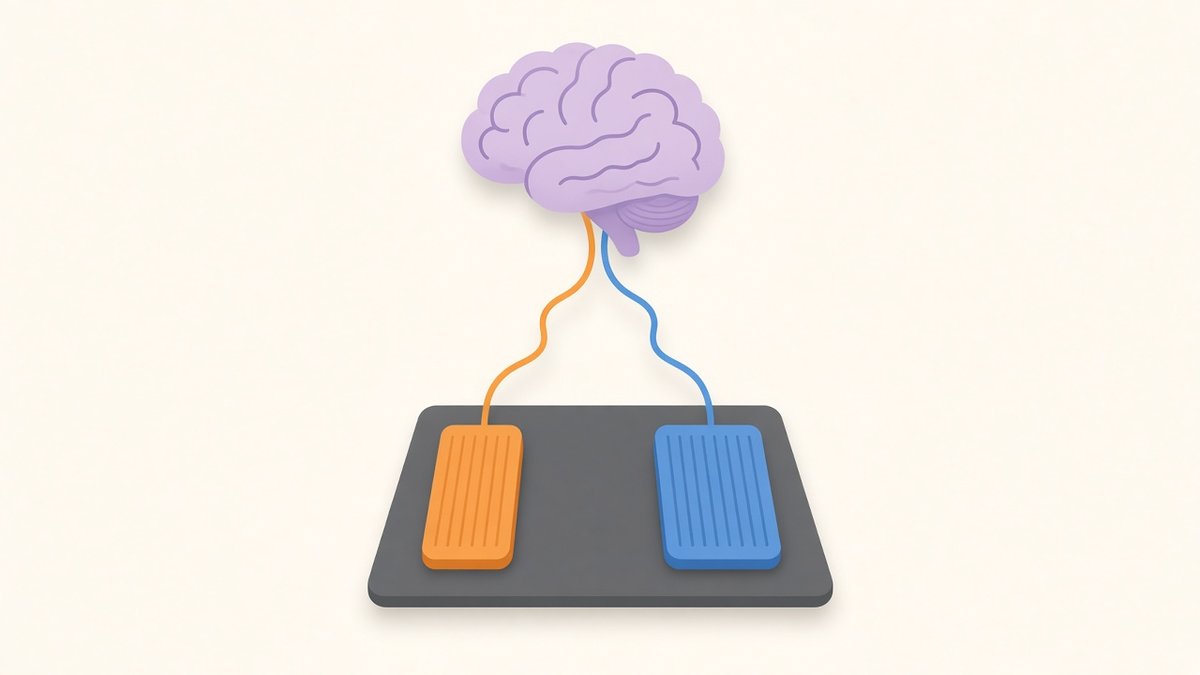
Picture your nervous system with a gas pedal and a brake. The gas pedal is the sympathetic nervous system, the part that gets you ready to act. The brake is the parasympathetic nervous system, the part that settles you down once things are fine again (Harvard Health Publishing, 2024).
When your brain spots something that looks like a threat, it presses the gas. Your body releases adrenaline, a hormone that gives you a quick burst of energy: your heart speeds up, you breathe faster, your senses sharpen. If the brain decides the danger hasn’t passed, a slower hormone, cortisol, follows and keeps you, in Harvard Health’s words, “revved up and on high alert” (Harvard Health Publishing, 2024).
The system is ancient and very good at its job. It was built for real physical danger, yet it reacts in much the same way to a traffic jam, pressure at work or a tense family situation (Harvard Health Publishing, 2024). In the healthy version, the moment passes, cortisol drops and the brake takes over. Gas, then brake.
Why you can’t just “think” yourself calm
This is the part people tend to find a relief. The gas gets pressed before you’ve had a chance to think. Harvard Health points out that it happens so fast you can jump out of the way of an oncoming car before you’ve even registered what you’re doing (Harvard Health Publishing, 2024). By the time you tell yourself “this is no big deal”, your body is already well on its way.
There’s a second twist. The part of the brain that plans, weighs things up and holds you back from saying the wrong thing, the prefrontal cortex, is very sensitive to stress. Neuroscientist Amy Arnsten found that even fairly mild stress, if it feels out of our control, can quickly weaken it, and faster, more reflexive emotional reactions take the lead (Arnsten, 2009). So when you try to reason with yourself in a stressed moment, you’re leaning on exactly the part of you that stress has just turned down. That sharp word you regret a minute later often starts right here.
If you recognise yourself in this and would like to talk it over with one of us, you can book a free 15-minute intro call.
When the foot stays on the gas
Trouble starts when the brake rarely gets its turn. Harvard Health compares long-term stress to a motor “idling too high for too long”. The neuroscientist Bruce McEwen called the slow wear and tear this causes allostatic load, which simply means the price the body pays for staying on alert too long (McEwen, 2007). Over time, chronic stress is linked to high blood pressure and to brain changes that may contribute to anxiety and depression (Harvard Health Publishing, 2024; Chu et al., 2024).
In everyday life it usually looks quieter than that. People describe it to us as feeling tired and wired at once, as small things suddenly feeling big, as weekends that never quite feel like rest. If you have ongoing physical or emotional symptoms, please see your doctor.
Giving the brake a chance
You can help the brake along. Harvard Health suggests slow, deep breathing from the belly, a brisk walk soon after a stressful moment, yoga or tai chi, and time with people you feel close to (Harvard Health Publishing, 2024). None of it is complicated, and it does help in the moment.
What we often notice, though, is that the same things keep pressing the gas: a certain kind of meeting, a certain tone of voice, the same thoughts at two in the morning. A walk helps you come down afterwards. It doesn’t change why the alarm went off.
Where wingwave® coaching comes in
Very often, what keeps pressing the gas is emotional stress the nervous system hasn’t finished processing: an old fear, a hurtful experience, a feeling that got stuck somewhere along the way. That’s where we work. wingwave combines eye movements like those of REM sleep, elements of NLP and a simple muscle test, which we do on ourselves for you in the online session. Together they help us find the specific triggers behind your reaction and process the emotions tied to them, without long analytical conversations and without reliving painful events.
In well over a thousand sessions we’ve seen it again and again: once those emotions are processed, the situations that used to set off the alarm lose their charge. You still notice them, but your body stops treating them as an emergency. Our article on how wingwave coaching can help with anxiety, panic and fear goes into more detail.
With an average level of load, about 12–14 wingwave sessions cover almost everything, and some topics settle in 3–4. Every session is online, in English or German. In a coming post we’ll write about the limbic system, and why some emotions get stuck there in the first place.

If your foot has been on the gas for a while, let’s talk. Book your free 15-minute intro call, tell us what’s going on, and we’ll tell you honestly whether wingwave coaching is a good fit for you.
Sources
- Harvard Health Publishing. “Understanding the stress response.” 3 April 2024, reviewed by Howard E. LeWine, MD. Accessed 19 October 2026.
- McEwen BS. “Physiology and neurobiology of stress and adaptation: central role of the brain.” Physiological Reviews 2007;87(3):873–904. doi:10.1152/physrev.00041.2006. Accessed 19 October 2026.
- Arnsten AFT. “Stress signalling pathways that impair prefrontal cortex structure and function.” Nature Reviews Neuroscience 2009;10(6):410–422. doi:10.1038/nrn2648. Accessed 19 October 2026.
- Chu B, Marwaha K, Sanvictores T, Awosika AO, Ayers D. “Physiology, Stress Reaction.” StatPearls, StatPearls Publishing; updated 7 May 2024. Accessed 19 October 2026.
wingwave is coaching, not therapy, and it is not a substitute for medical or psychological treatment. If you are in crisis or have a diagnosed condition, please consult a qualified professional.